
Problem
Air taxis and delivery drones are expected to fly autonomously over cities, but public trust is low: in one survey cited in this work, only 26% of respondents trusted autonomous air taxis. Before these vehicles can fly on their own, their controllers need a clear safety guarantee: the set of states from which the vehicle can still avoid a collision or reach its landing pad. Computing that set means solving a Hamilton-Jacobi equation, and grid-based solvers become impractical for realistic vehicle models with 6 to 12 states. Learning-based controllers scale better, but they are hard to certify.
Approach
The first line of work learns the safety guarantee instead of gridding it. A physics-informed neural network is trained to satisfy the Hamilton-Jacobi equation and its boundary conditions, building on the open-source DeepReach framework. The learned value function gives the reachable set directly, and the safe control follows from it. Results are checked against hj_reachability, a JAX-based numerical solver.
The second line of work brings camera-based 3D models into path planning. A neural radiance field, trained with nerfstudio on images from several viewpoints, turns an object into a 3D point cloud. Its convex hull can stand for the robot’s own shape, an obstacle or the goal. The robot’s reachable sets are computed in closed form as polytopes, so a model predictive controller only has to satisfy linear inequality constraints to stay clear of every obstacle.
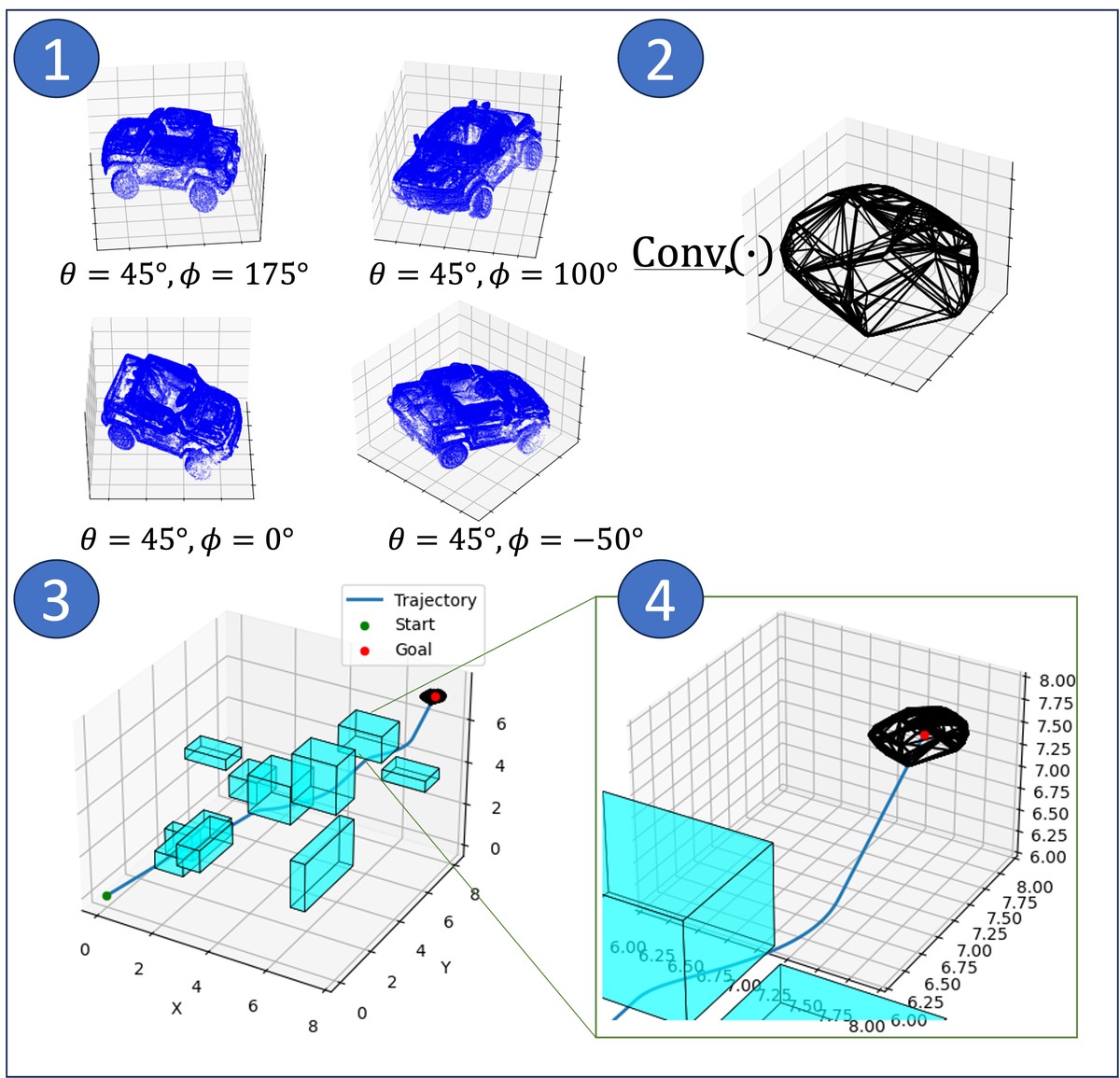
From images to a safe path: (1) an object recovered from a neural radiance field, seen from several angles, (2) wrapped in a convex hull, (3) a collision-free path through randomly placed obstacles to a goal defined by that object, and (4) a close-up of the goal. Adapted from Safe Navigation using Neural Radiance Fields via Reachable Sets, ICMCR 2026.
Outcome
- Learned safety that matches a numerical solver. On the Air3D benchmark, where two UAVs must avoid a collision, the physics-informed network reproduces the nonconvex reachable tube computed by a numerical solver.
- Safe vertiport landing. The same approach finds every state from which a UAV can land safely on a vertiport.
- Collision-free planning with NeRF models. Closed-form reachable sets keep the planner clear of obstacles in two cluttered scenarios, using a NeRF object as the robot’s shape in one and as the goal in the other. The NeRF model trains in about 18 minutes on a single CPU.
- Published and patented. Papers at AIAA SciTech 2024 and ICMCR 2026, and a patent application on AI-based safe control for unmanned aerial systems.