Problem
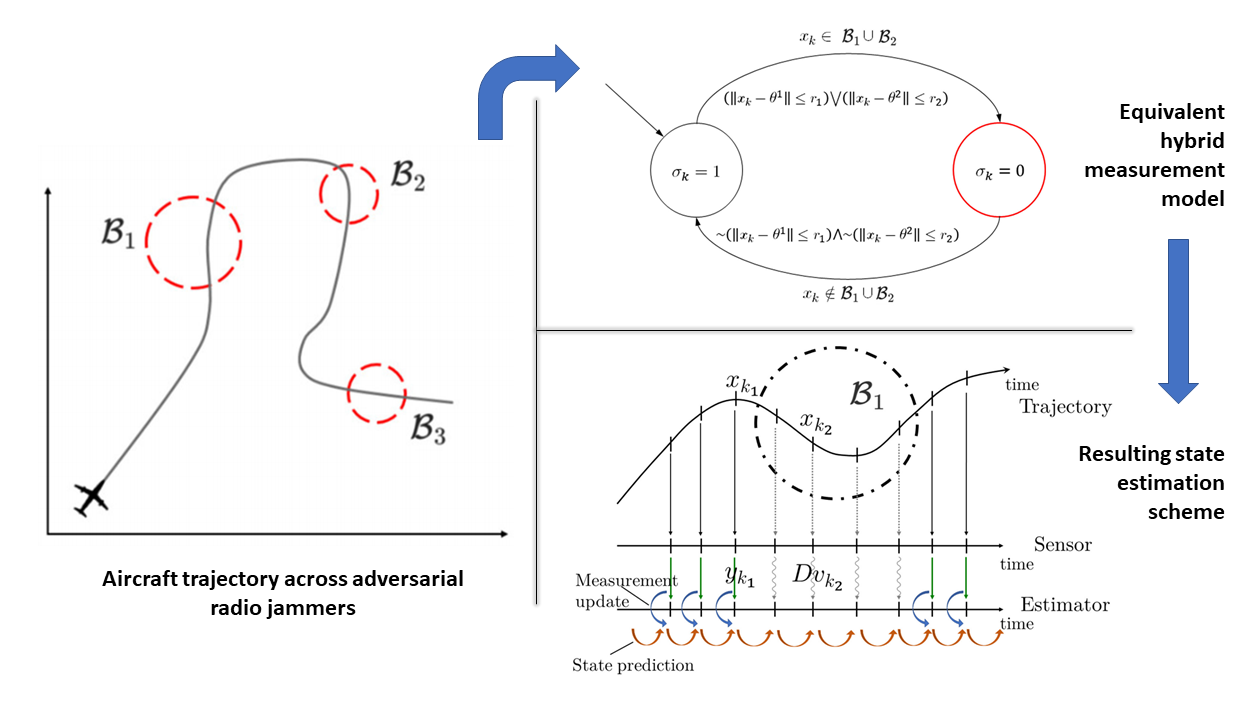
Air traffic surveillance, like many tracking systems, relies on measurements sent over imperfect communication links. Packets get dropped, sometimes at random and sometimes in predictable places, such as regions with poor coverage or radio jamming. A standard Kalman filter assumes every measurement arrives, so its estimates degrade exactly where losses cluster. When many sensors track the same aircraft, each sees only part of the picture and has to agree with its neighbours over a network whose connections keep changing.
Approach
The first line of work models packet arrival explicitly. For random losses typical of real communication channels, and for losses that depend on where the tracked object is, the estimator keeps the familiar Kalman filter structure but updates its uncertainty to reflect the chance that each measurement arrives, using prior knowledge of where losses are likely.
The second line of work spreads estimation across a sensor network. Each sensor runs a local estimator for a system that switches between operating modes and shares its estimates with neighbouring sensors, so the whole network reaches agreement even as its connections change over time.
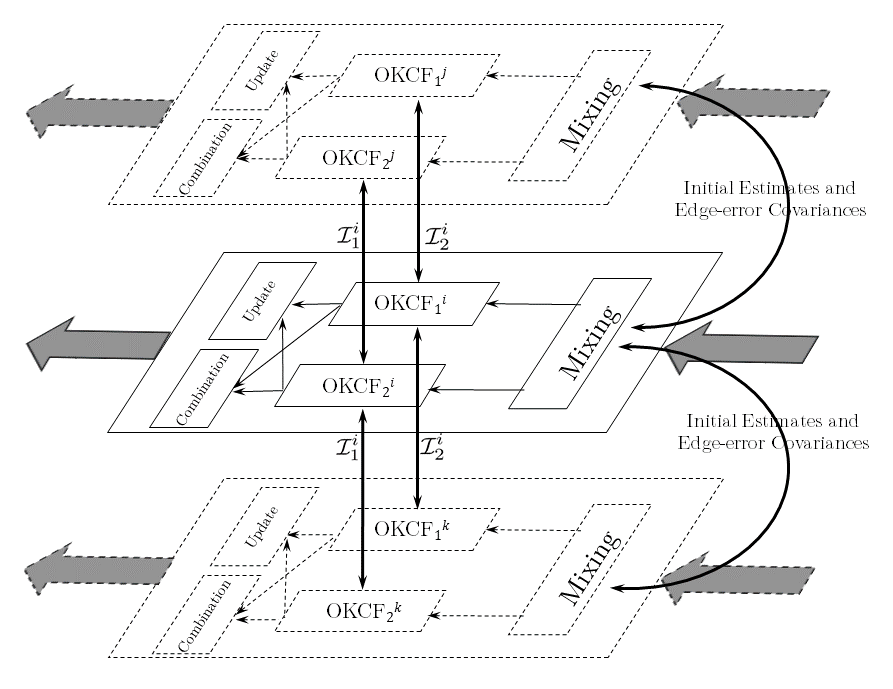
How one sensor (center) updates its estimate: it runs one filter per operating mode, mixes and combines them, and trades estimates and error covariances with neighbouring sensors (above and below). Adapted from Distributed state estimation for a stochastic linear hybrid system over a sensor network, IET Control Theory & Applications, 2018.
Outcome
- More accurate tracking under patchy communication. On an aircraft tracking example with location-dependent packet losses, the new filter outperforms the baseline packet-loss filter at similar computational cost.
- Distributed estimation on changing networks. The consensus-based estimator outperforms existing hybrid estimators at comparable per-sensor complexity, while allowing the network’s connections to change.
- Published. Two IET Control Theory & Applications papers (2018, 2019) and an IEEE CDC 2017 paper. The packet-loss work formed the basis of an M.S. thesis at Purdue, and the distributed estimation work was supported by the NSF (CMMI 1335084).