Problem
Hybrid language models such as NVIDIA’s Nemotron-H and TII’s Falcon-H1 now combine attention with state space model (SSM) layers at tens of billions of parameters. Interpretability tools can already find the layer where an SSM computes a behaviour, but not which part of its recurrent state carries it. Two properties stand in the way. An intervention at a single step is undone as later inputs rebuild the state, and any change of coordinates gives an equally valid state, so a single state coordinate has no fixed meaning.
Approach
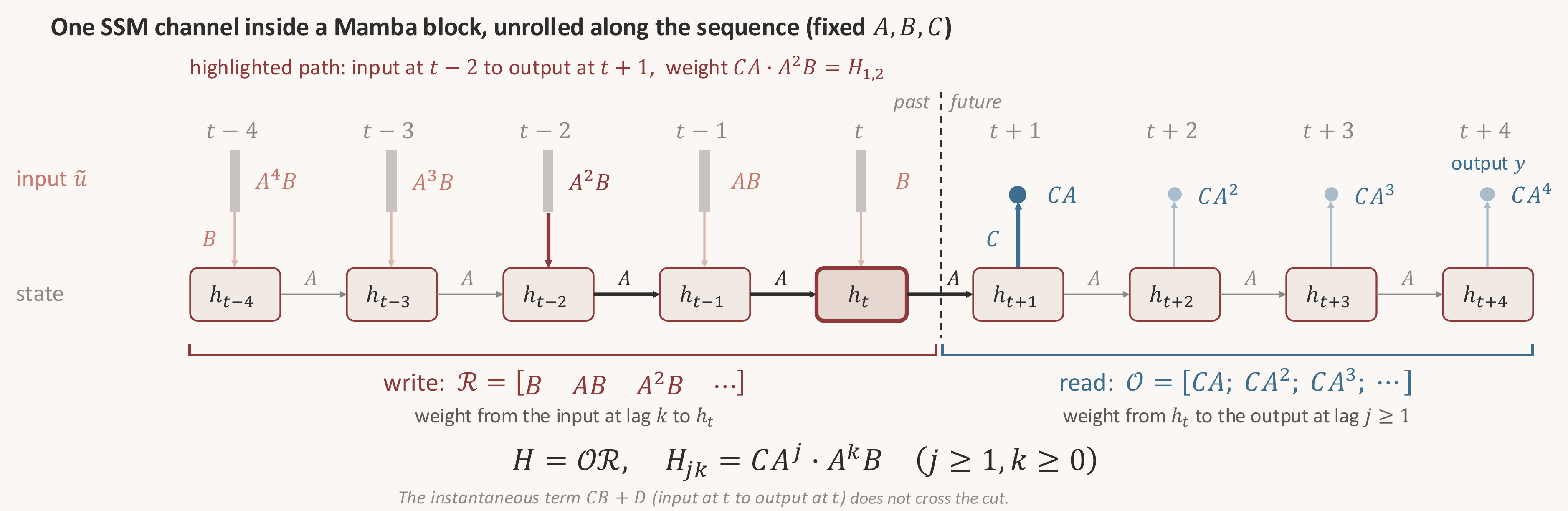
Control theory has a coordinate-free answer to the question of which state directions matter. Balanced realization ranks them by how strongly the past writes into them and the future reads from them, and the ranking, given by the Hankel singular values, does not depend on the coordinates we start from. This project treats the top balanced directions as candidate features of the recurrent state, much as transformer interpretability treats subspaces of the residual stream, and tests them by removing a direction at every step of the sequence.
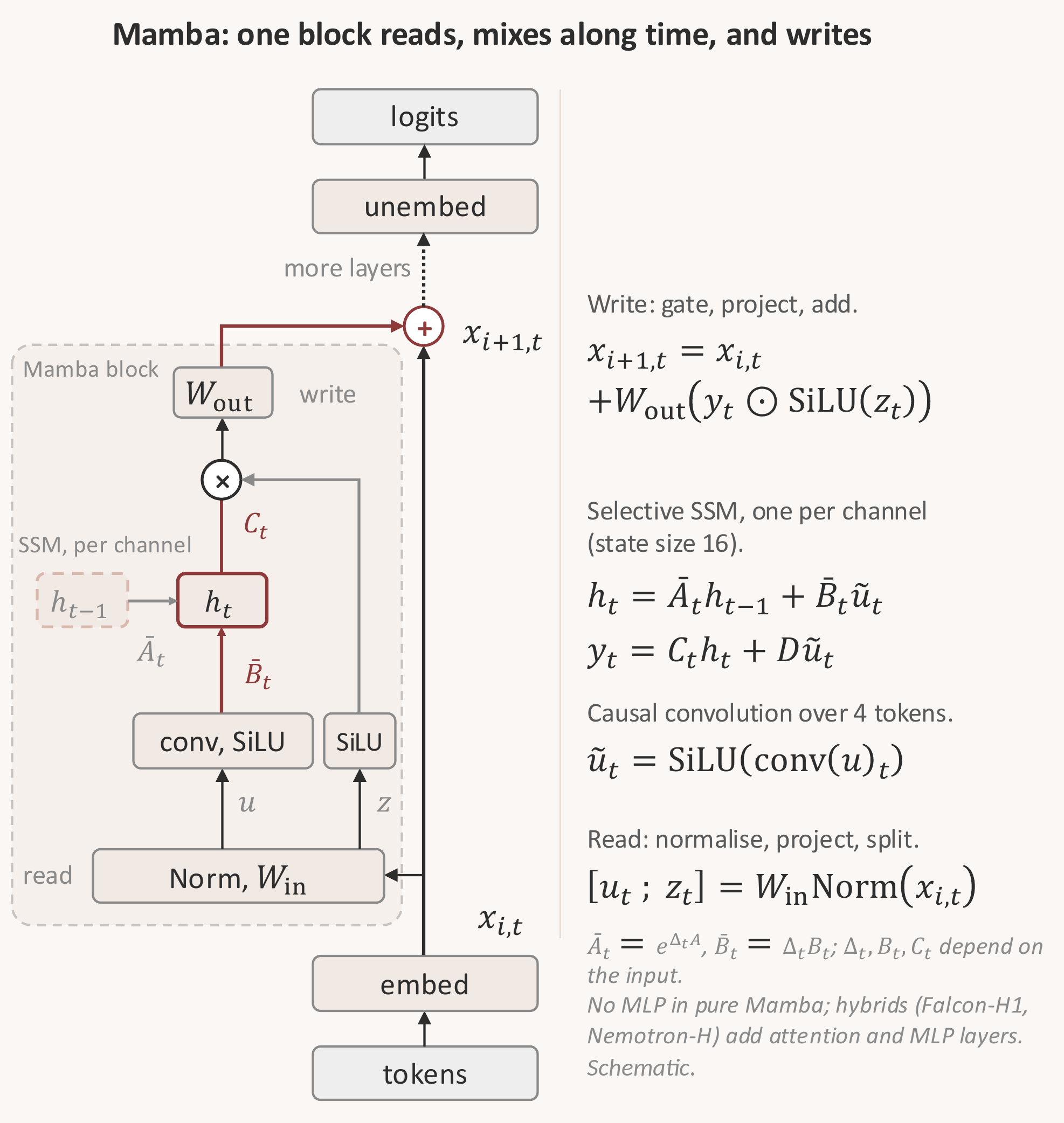
A Mamba layer reads the residual stream through an input projection and writes back through an output projection, much as an attention head does; the selective SSM between them keeps a small state in each channel. From A Privileged Basis for the Recurrent State of SSMs.
- Do the top balanced directions carry a behaviour? In small linear SSMs trained on synthetic tasks with well-separated timescales, removing the top balanced direction affects its own output channel about 250 times more than the others, while an intervention at a single step is far less selective (blog post).
- Can the picture be carried over to Mamba? In each channel of a Mamba layer, the input-dependent parameters are averaged over a corpus to give a fixed linear system. A first proxy, which keeps only each channel’s most controllable direction, locates the layers that matter for indirect object identification and induction from 130M to 2.8B parameters. The test of the balanced directions themselves is in progress.
- How do attention and SSM layers divide the work in hybrids? Layer knockouts suggest that the arrangement matters: attention carries most of the IOI effect in Falcon-H1, where the two run side by side, while early SSM layers carry the largest single effects in Nemotron-H-56B.
Outcome
- A principled candidate for the features of a recurrent state. Balanced directions from control theory, proposed as a privileged basis for the state of an SSM, with a test that can show the idea is wrong.
- Early evidence at small scale. In linear SSMs, removing the top balanced direction disrupts the output it carries about 250 times more than the others.
- Experiments across nine models. Pure Mamba from 130M to 2.8B parameters, and two hybrid families up to 56B.
- Released early. Open-source analysis code, and per-layer statistics for Mamba models from 130M to 2.8B on Hugging Face.