Problem
Colocation contracts promise each tenant specific limits on power, temperature and humidity, with penalty credits when those limits are broken. The terms that matter, such as a measurement window, an exclusion or a deadline for claiming credits, are scattered across long contracts and worded differently by every vendor. Monitoring is usually reactive: a breach is noticed only after it has already cost money.
Approach
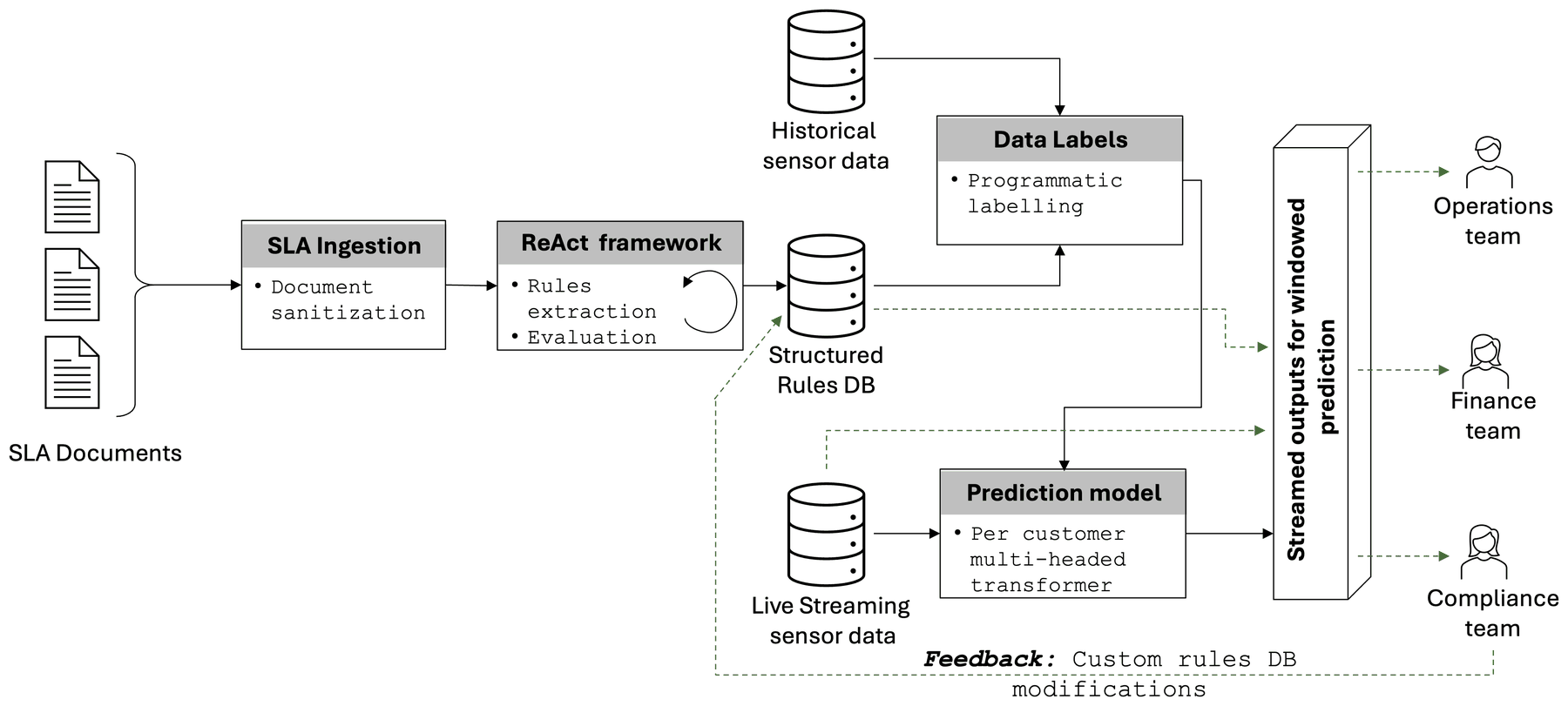
AI agents read each SLA contract and turn it into structured, machine-checkable rules. Every rule carries the exact contract text it came from, and a verification step checks that quote against the source before the rule is used.
Those rules then drive monitoring. They label historical sensor data automatically, so no manual annotation is needed, and they train a model for each customer in which every attention head tracks one SLA rule. Its predictions reach three audiences: credit exposure for finance, risk scores and suggested actions for operations, and an evidence trail for compliance.
Outcome
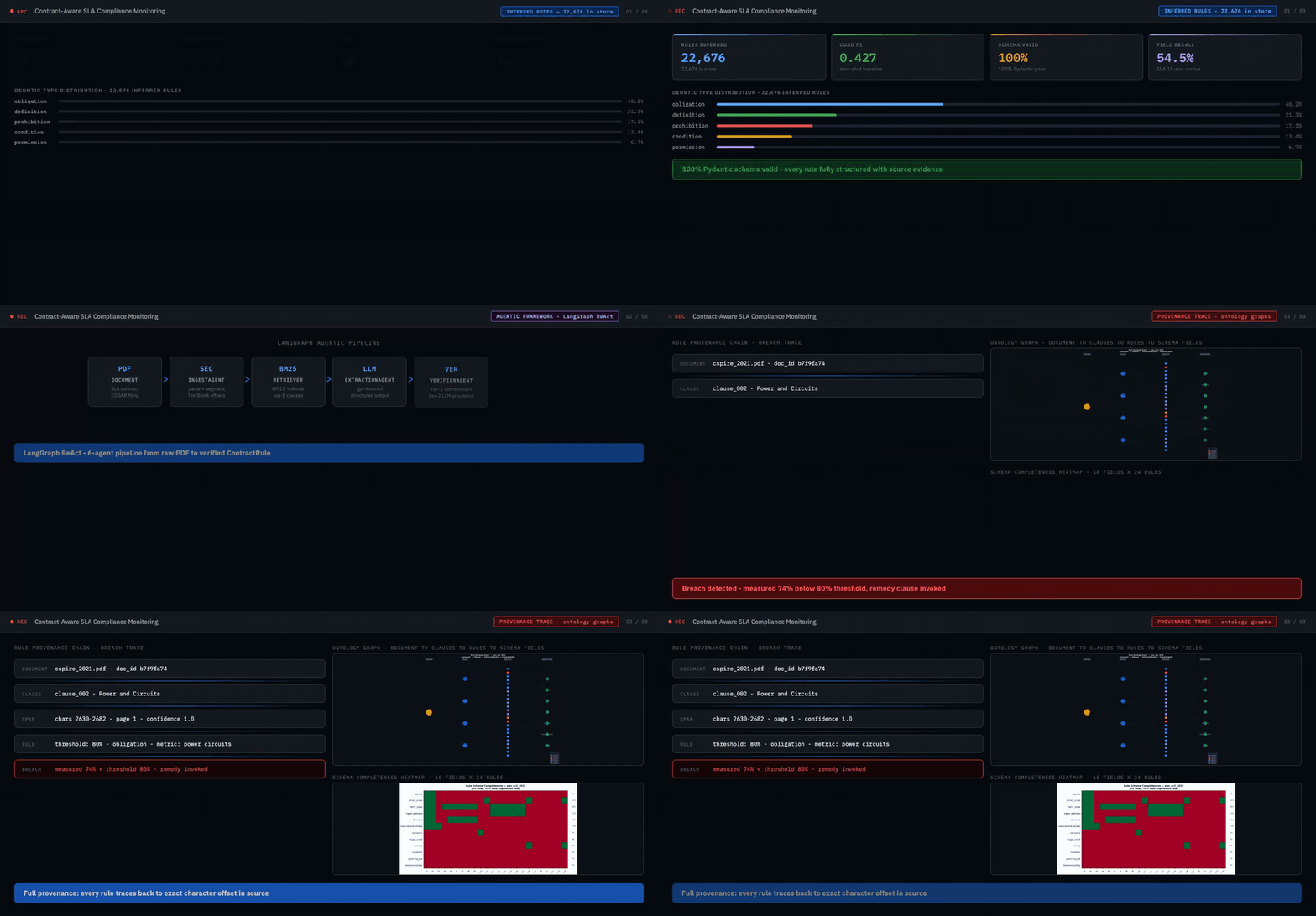
Proof of concept: the working platform, from extraction metrics to the processing pipeline to a full provenance trace, ending in a detected breach and the remedy clause it triggers.
- Breaches predicted about 30 minutes ahead. Operators get time to act before a violation costs money, instead of finding out afterwards.
- Over 22,000 contract rules, each traceable to its source. Every rule points back to the exact contract text it came from, so any alert can be audited.
- A working end-to-end platform. It runs from a raw contract all the way to a breach alert and the remedy clause it triggers.
- Strong results on legal benchmarks. It scores up to 100% on LegalBench contract-review tasks such as governing law and termination for convenience, and lifts ContractNLI accuracy from 65% to 78%.
- Published, patented and heading to market. Papers at IEEE ICDCS 2026 and an ICML 2026 workshop, a patent application filed, and the solution is now going through commercialization.