Part 1:https://omanshuthapliyal.github.io/blog/hrt-conjecture/
In the previous post, I talked about the HRT conjecture as a rather natural statement about phase space. A signal can be moved in time. It can also be moved in frequency. Moving it in time changes where its envelope lives. Moving it in frequency changes the pitch of its oscillations. If we do both, we obtain a time-frequency shifted version of the original signal.
Using a symmetric convention, one writes this operation as $$(\rho(x,\omega)f)(t)=e^{2\pi i\omega(t-x/2)}f(t-x).$$ The point $$(x,\omega)$$ tells us where we moved the function in time-frequency phase space. The HRT conjecture said that distinct points in phase space should produce distinct, linearly independent copies of a nonzero function. More explicitly, if $$z_1,\ldots,z_N\in\mathbb{R}^2$$ are distinct, and $$f\in L^2(\mathbb{R})$$ is nonzero, then one should never be able to find nontrivial coefficients $$c_1,\ldots,c_N$$ for which $$\sum_{k=1}^{N}c_k \rho(z_k)f=0.$$
This was an extremely believable conjecture.
If I shift a wave packet in time, it moves. If I modulate it, the frequency changes. If I do different combinations of both operations, why should a finite number of them somehow arrange themselves into a perfect cancellation over the entire real line? It feels a little like taking several copies of the same violin note, moving each one to a different place in time and changing the pitch of each one, and then expecting their sum to vanish everywhere.
For roughly thirty years, the answer appeared to be: they cannot. But, in August 2026, a counterexample was constructed.
Not using a pathological function. Not using an object which only barely belongs to $$L^2$$. The counterexample uses a nonzero Schwartz function: infinitely differentiable, rapidly decaying, and very much the sort of wave packet one would have expected to behave nicely.1
The conjecture, in full generality, is false.
A lattice may be too rigid
Recall the vehicle example from the previous post. When one is checking a lane change, the rear-view mirror does not show everything behind the car. But it does show a large and structured part of the road. A car can be nearby, perfectly real, and still fail to appear in the mirror if it sits in the narrow wedge between the regions the mirror covers.
The important point was that the blind spot is not the whole road. Most locations are visible. Most positions are covered by the mirror geometry. The blind spot exists because the mirror is almost doing the right thing, but not quite doing the right thing everywhere.
Linnell’s theorem is a little like having a perfectly arranged set of mirrors. If all the time-frequency shifts live on a genuine lattice, the geometry is rigid enough that HRT cannot fail. There is no blind spot. The shifts may interact, but they cannot hide a finite linear dependence inside the algebra generated by the lattice.1 So a counterexample cannot simply live on a lattice. But it cannot escape lattice structure entirely either.
A completely arbitrary collection of phase-space points gives us nothing to hold onto analytically. There is no natural return map, no useful periodicity, and no obvious way to understand how all the shifts interact. The first 12-point counterexample sits in the uncomfortable region between these two situations. Eleven points belong to an irrationally translated half-lattice. The final point is the origin.
The configuration is close enough to a lattice that the authors can still unfold its geometry into a tractable dynamical system on a torus. But it is not contained in the lattice setting protected by Linnell’s theorem. This is the blind spot.
The figure below is only a map of where the blind spot is. It is not yet the proof that the twelve shifts cancel. The proof comes later: after applying a vector-Zak transform, the authors construct a smooth invariant direction for the resulting torus dynamics, solve a scalar compatibility condition, and unfold that object back into a nonzero Schwartz function on the real line.2
But the geometry tells us why such a proof has somewhere to live. The conjecture did not fail in the middle of the rigid lattice world. It failed just outside its field of view.
Below I show a simple simulation of the Autonomous Car driving around, trying to echolocate using radar pulses that bounce back, from the previous post. The bouncing back itself is a combination of frequency-time shifts, and I try to create a scenario where (a) first the objects are placed in a lattice (in the frequency-time phase space), and (b) they are not symmetrically placed at all. And I show below that the linear dependence resulting from lack of symmetry causes a blind spot (where the bounded back wave perfectly cancels out the remaining waveform sum).
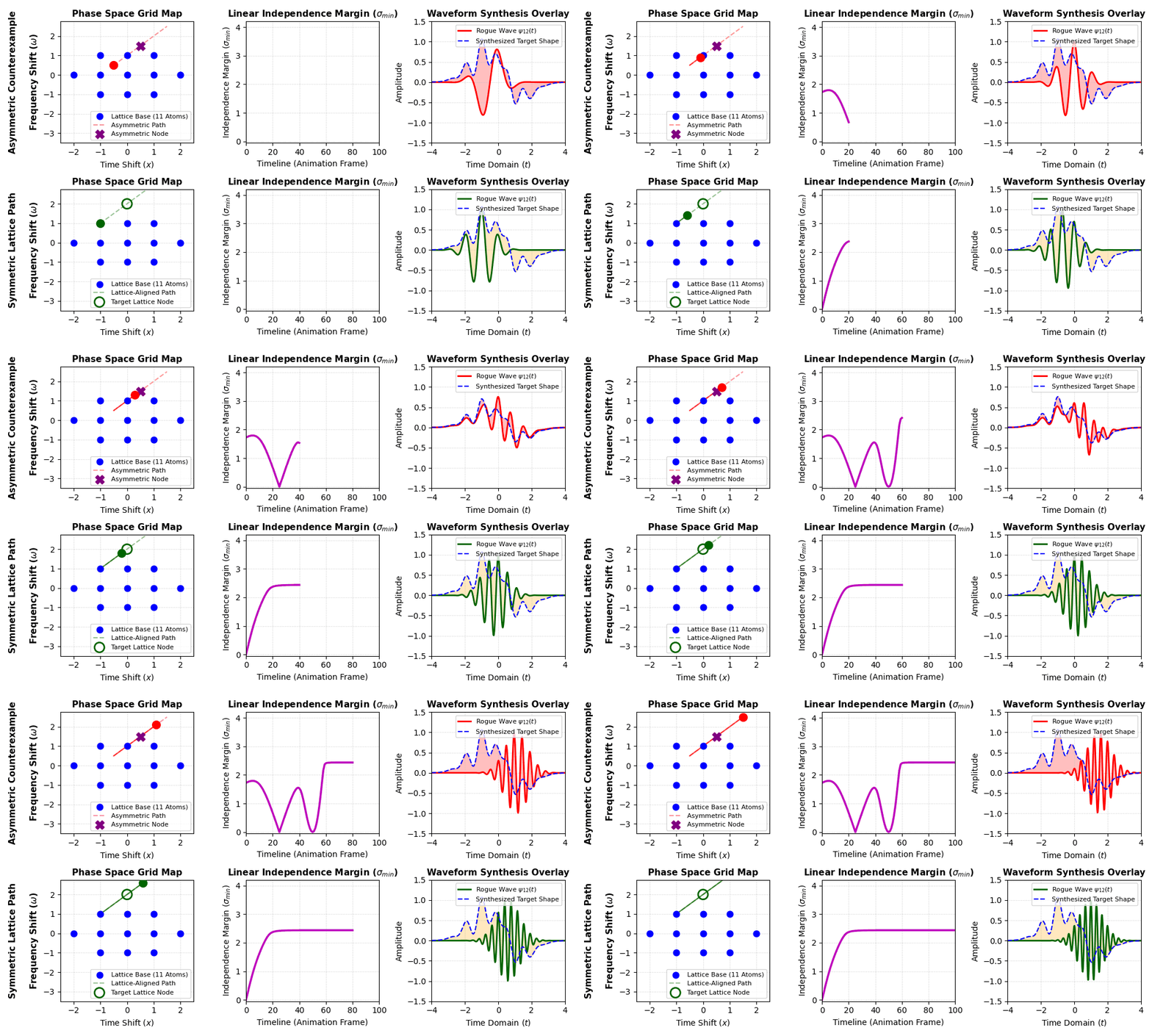
Figure 1. The 11+1 geometry of the first HRT counterexample.
The blue points represent eleven shifts inside an irrationally translated half-lattice. The red point is the origin. This schematic’s purpose is to show why the configuration lies close to the lattice regime while avoiding the exact lattice hypothesis in Linnell’s theorem.
So the mathematical blind spot from the previous post indeed appears clearly in asymmetric waveform case!
Afterword
Why smoothness does not save the conjecture
One might have expected that any counterexample to HRT would need to use a very strange function. After all, if a function has sharp discontinuities, slow decay, or some unpleasant irregularity, perhaps one can imagine exploiting that structure to create cancellation. But the window in the counterexample belongs to the Schwartz space, $$ \mathcal{S}(\mathbb{R}). $$ This means that the function is infinitely differentiable, and it decays faster than every inverse polynomial. Its derivatives do the same.
For every nonnegative $$m$$ and $$n$$, $$ \sup_{t \in \mathbb{R}} \left| t^m f^{(n)}(t) \right| < \infty. $$ This is about as far as one can get from a jagged pathological example. However, this does not mean that every rapidly decaying function behaves the same way. A Gaussian, $$ g(t)=e^{-t^2}, $$ has a stronger kind of decay. There are positive HRT results for functions with sufficiently strong Gaussian-like decay. Intuitively, the tails of the shifted functions disappear so aggressively that they cannot sustain the long-range interference needed for a global cancellation.3
A Schwartz function is still extremely well behaved. But it leaves a little more room. The counterexample lives in that room! It is smooth enough to look harmless, but not so rigid that the geometry of its time-frequency shifts is forced to remain independent.
The authors do not begin by writing down twelve shifted functions and somehow guessing the coefficients which make them vanish. Instead, they package eleven time-frequency shifts into one operator: $$ P_*=\sum_{k=1}^{11} c_k\rho(z_k). $$ Then they seek a function $$f_*$$ for which $$P_*f_*=c_*f_*.$$
In other words, they look for an eigenfunction. Once this is achieved, the desired twelve-term relation follows immediately: $$ -c_*f_*+\sum_{k=1}^{11} c_k\rho(z_k)f_*=0. $$ The twelfth point is the origin. It corresponds to the unshifted copy of the function. I find this reframing useful. The original question is: can twelve distinct time-frequency shifts cancel? The new question is: can a specially designed combination of eleven shifts possess a smooth, rapidly decaying eigenfunction?
It is still a difficult question, but it is no longer a completely shapeless one.
Folding the problem until it becomes visible
The proof then uses something called a Zak transform. The Zak transform takes a function on the real line and reorganizes it into an object living on a torus. This is useful because translations and modulations, which look global and awkward on the line, become more structured after this transformation.
The actual construction uses a two-component version of this transform. One can think of it as folding the real-line problem into a two-dimensional, periodic phase-space picture. After this folding, the problem is no longer primarily about twelve wave packets on the line. It becomes a question about a small matrix which changes as one moves around a torus.
The authors construct this matrix field to be close to a simpler rank-one object. A rank-one map has a preferred direction: it compresses nearly everything onto a line. The important fact is that this preferred direction survives the perturbation. So, rather than the geometry of the problem wandering freely across all possible directions, there is a hidden line which is carried consistently along the torus dynamics.
The rest of the proof is essentially about turning this hidden direction into an honest-to-goodness Schwartz function on the real line. There is an irrational shift involved, and this produces a familiar small-divisor issue. The same irrationality which helps the configuration escape lattice rigidity also has to be controlled carefully enough that the resulting construction remains smooth. This is where the arithmetic choice of the phase-space translation matters. The irrationality is not decorative. It is doing two jobs at once. It breaks the lattice theorem. And it remains structured enough that the torus dynamics can still be solved.
Where the computer enters
There is a computer-assisted component to the proof, but it is worth being precise about what this means. The computer is not asked to search through a large list of candidate functions and announce that one seems to work. Instead, interval arithmetic is used to verify a bound uniformly over the torus.
Ordinary floating-point computation might tell us that a quantity appears smaller than some threshold. Interval arithmetic instead returns a guaranteed interval containing the true value, including all rounding errors. The verification shows that the true matrix field remains sufficiently close to the simple rank-one model. That closeness is what gives the proof its hidden contracting direction. So the computer-assisted part is not replacing the mathematics. It is making a particular analytic estimate rigorous in a situation where an ordinary symbolic bound would be rather unpleasant.
I think this is a useful way to understand the role of computation in modern mathematics. The computation is not the explanation. The geometry is the explanation. The computation verifies that the geometry is strong enough.
It would be easy to say that the HRT conjecture failed because phase space is messy. But this is not really what happened, and I want to emphasize that the counterexample is not random. It is almost too structured to be called messy. A pure lattice is too rigid. A completely arbitrary configuration gives us no traction. The 12-point construction sits in the uncomfortable region between the two. It has enough lattice-like structure to be folded into a tractable torus problem. It has enough irrationality to evade the theorem which protects genuine lattices. And it has a smooth enough function to prevent the counterexample from being dismissed as pathological.
The result is not that time-frequency shifts are generally easy to make dependent. The result is more unsettling. There are very smooth wave packets, and very carefully arranged phase-space locations, for which distinct time-frequency shifts can conspire to cancel perfectly.
For thirty years, the conjecture suggested that phase space had a certain kind of rigidity. The counterexample does not destroy every piece of that rigidity. It shows that the rigidity had a gap.
Update. The 12-point construction was the first explicit Schwartz-class counterexample. Further recent work claims that four points already suffice. I will return to this separately, since reducing the geometry from twelve points to four is not merely a smaller example; it changes the question of how little structure is needed before HRT can fail.3
Part 3: https://omanshuthapliyal.github.io/blog/hrt-conjecture-part-3/
M. Faulhuber, P. Petersen, J. T. van Velthoven, and F. Voigtlaender, Linear dependence of time-frequency shifts of a Schwartz function, 2026. The original 12-point counterexample. ↩︎ ↩︎
P. A. Linnell, von Neumann algebras and linear independence of translates, Proceedings of the American Mathematical Society, 127(11), 1999. ↩︎
T. Tao, A partial digestion of the HRT counterexample, 2026. A blog-level explanation of the original counterexample and subsequent developments. ↩︎ ↩︎